Beethoven Orchester Bonn, Stefan Blunier – Eugen D’Albert: Der Golem – Opera in 3 Acts (2010) [SACD / MDG – MDG 937 1637-6]

Beethoven Orchester Bonn, Stefan Blunier - Eugen D’Albert: Der Golem - Opera in 3 Acts (2010)

Title: Beethoven Orchester Bonn, Stefan Blunier – Eugen D’Albert: Der Golem – Opera in 3 Acts (2010)
Genre: Classical
Format: MCH SACD ISO + Hi-Res FLAC

Almost everything about the opera Der Golem is unusual, including its composer, Eugen D’Albert (1864-1932). Born in Glasgow to an English mother and German-born father of French and Italian extraction, he won a scholarship to the National Training School of Music in London at age twelve, studying under John Stainer and Arthur Sullivan. D’Albert began establishing himself as a piano virtuoso while still a student but in his late teens repudiated both his English citizenship and English musical training, becoming a German citizen and embracing German culture and language so thoroughly that he changed his first name from Eugène to Eugen and refused to write operas (of which he produced twenty-one) in any language other than German. Even when he embarked on his most popular opera, Tiefland (1903), which takes place in Spain and is based on a Spanish novel, D’Albert adamantly rejected the idea that it be in any language but German. So he produced a strange cross between Latinate verismo and early German Expressionism.

He was married six times and died while in Riga, Latvia, seeking a divorce from his sixth wife, presumably so he could marry his mistress, Virginia Zanetti. But his last marriage, to one Hilde Fels, had come unraveled long before this when, in 1923, he met the forceful Margit Labouchère. Apparently being putty in the hands of a woman, at least until he moved on to the next one, D’Albert fell under the influence of Labouchère, an occultist, who prevailed on him to write an opera based on the Jewish folktale of the golem. While the myth of the golem, an inanimate object brought to life by humans and endowed with supernatural strength, is centuries old, the story took on specificity in the eighteenth century when Jews in the Prague ghetto began ascribing the act of creating a golem to a historical figure, Rabbi Loew, an expert in the kabbalah and its mysteries, just as the German magician and alchemist Johannes Faustus had become mythologized in the sixteenth century. D’Albert’s libretto is based on the legends from the Prague ghetto as well as a 1908 play by Hungarian playwright and rabbi Arthur Holitscher. The streamlined story lends itself to a brief summary: Rabbi Loew and his young disciple return to the Rabbi’s workshop with the golem, which they have formed out of clay and animated using cabalistic rituals. The Rabbi wakes his stepdaughter Lea and sends her away so that they can work in secret. He intends to make the golem, who possesses superhuman strength, his household servant. In the meantime, Kaiser Rudolf enters, seeking diversion from the Rabbi, whose feats of legerdemain are well known. After a kaleidoscope show, Rudolf departs, and the pair return to their work, which proves so successful that the Rabbi grants the disciple his wish—Lea’s hand in marriage. But she is taken with the golem and wants to know more about him. Slowly, she teaches the golem to speak. In the Rabbi’s absence, the disciple tries to win Lea’s love, but her thoughts are on the golem alone. Once the disciple leaves, they strike up a conversation, but when Lea taunts the golem, he threatens her and she faints. He realizes that he has fallen in love with her. She professes her love for him as well. The Rabbi returns and tries to part the unlikely lovers. The incensed golem then goes on a rampage through the ghetto. The disciple and two Jews have taken refuge in the observatory of astronomer Tycho Brahe; they discuss the horrors that the golem has visited on the ghetto. Other inhabitants take asylum, telling their own tales of woe. Finally, the Rabbi appears, vowing to take on the golem himself, though he decides he’s powerless over the creature and so turns to Lea, whose singing entices the golem to calm down. But in her effort to pacify the golem, she has expended her own life force. The golem, seeing that his beloved is no more, turns again to lifeless clay. Too late, the Rabbi realizes that he has overstepped the bounds of human wisdom and usurped powers that should be the Creator’s alone. The music that D’Albert supplies for this dark and fantastic story is itself dark-hued and highly chromatic. The fledgling Expressionist gestures of his earlier opera Tiefland have matured here, but as in Tiefland, the lovers’ passions are rendered in music of high-Romantic songfulness, a remnant of Wagner’s influence even at this late date (1926). The music may not be utterly individual in style, but this combination of influences creates a unique sound picture. As in many operas with a limited cast, the opening scenes seem to drag, though in a staged performance the atmosphere conjured in the music would undoubtedly make an even greater impact in the context of stage business and set design. The visit of the Kaiser seems like the most expendable of subplots, but even this might have its dramatic points when staged. And the Rabbi’s magic show, presented as an orchestral interlude, gives witness to D’Albert’s considerable skills at orchestration. On the other hand, there’s no denying the strange appeal of the scenes between Lea and the golem, with their mix of tension, lyricism, and raw passion. The crowd scenes in the last act ratchet up this tension effectively. It’s not hard to see why this weird opera was a hit at its premiere in Frankfurt—and given the rise of the Nazis just seven years later, why it languished for decades without many an airing. The current recording is taken from of series of live performances at Theater Bonn in January of this year. Among the soloists, German soprano Ingeborg Greiner stands out by virtue of her part, which is central to the opera. Her light, attractive lyric soprano is well suited to Lea, who is young enough to be experiencing love, with all its vicissitudes, for the first time and yet who proves mature enough to perform an act of ultimate heroism. As the golem, American baritone Mark Morouse has an equally challenging task in portraying a creature who masters language in the course of the opera, as well as balancing the most brutish of impulses against more tender human emotions. Both singers convince in their roles. The role of the disciple is a pretty thankless one, calling for a certain callowness, if not downright cluelessness. Tansel Akzeybek acquits himself well in the part; his voice is an attractive one, and he manages to inject just the right air of youthful uncertainty into his singing. Of the principals, bass Alfred Reiter takes the most getting used to for me. He’s probably a fine stage presence, but I have a less than favorable opinion of his ample vibrato, especially since the recording seems to add a strange halo of reverb around his vocalizations. I’m told this is a strange side effect of the live recording itself – a sort of cupola directly above the singers. It’s unfortunate, seeming more apt to the soundtrack of a horror flick than an opera recording. Speaking of recording, this one simply doesn’t do justice to the orchestra and chorus. Having heard the Beethoven Orchestra Bonn in their very present recording of Shostakovich’s Symphony No. 11 (on an MD&G SACD), it’s a leap to think of this as the same group. The orchestra is recessed in a recording that’s low level to begin with, so you really have to crank the volume to hear the music as it’s supposed to sound. That, of course, amplifies the stage noises, which admittedly aren’t as intrusive as in some other recordings. But still, they’re there. And increasing the volume also flattens the sonic image, as well as negates the natural ambience of the hall. Thus my report must be a mixed one. The opera is very much worth hearing—and owning (though I wish MD&G had supplied an English translation of the libretto). The performances are for the most part on target. The recording, especially given that it’s supposed to provide an audiophile experience, is lacking. So I guess this must be a qualified recommendation, but a recommendation nonetheless, given the quality of D’Albert’s music. – Lee Passarella audiophile audition

(more…)

8 min read

Beethoven Orchester Bonn, Czech Philharmonic Choir Brno, Roman Kofman – Franz Liszt: Christus Oratorio (2006) [SACD / MDG Gold – MDG 937 1366-6]

Beethoven Orchester Bonn, Czech Philharmonic Choir Brno, Roman Kofman - Franz Liszt: Christus Oratorio (2006)

Title: Beethoven Orchester Bonn, Czech Philharmonic Choir Brno, Roman Kofman – Franz Liszt: Christus Oratorio (2006)
Genre: Classical
Format: MCH SACD ISO + Hi-Res FLAC

This brand new recording of Franz Liszt’s massive oratorio, ‘Christus’ is doubly welcome as it is a new version for some years now and it enshrines some great singing and orchestral players all under the knowing guidance of Roman Kofman. The oratorio is split into three distinct parts or acts lasting about an hour each with the first one designated as a Christmas Oratorio. The orchestra plays a hugely important part here with an extensive introduction lasting almost a quarter of an hour after the soloists and choir get a look in. I had been familiar with Erato’s excellent recording under James Conlon but that is currently unavailable and dates back to 1982, almost a quarter of a century and I must say that I hugely enjoyed Kofman’s brisk and unalloyed style. In the second part described as ‘Epiphany’, we have some lovely interpretations, especially the magnificent ‘Entry into Jerusalem’ which is fairly apocalyptic in its intensity. What is most characteristic about this oratorio is the way it is built into huge blocks that are quite symphonic in their treatment. The third part is called ‘Passion and Transfiguration’ and almost resembles Mahler in its glorious intensity especially in the final ‘Et Resurexit’ I already indicated the excellent qualities of the soloists especially Franziska Hirzel and Birgit Remmert who sing with that important ethereal intensity. Kofman conducts with the ideal tonic and lets the music move along quite magically. The SACD sound comes out trumps on my Sony SACD-11 player and I really have nothing but an unqualified recommendation for this beautiful set.

(more…)

2 min read

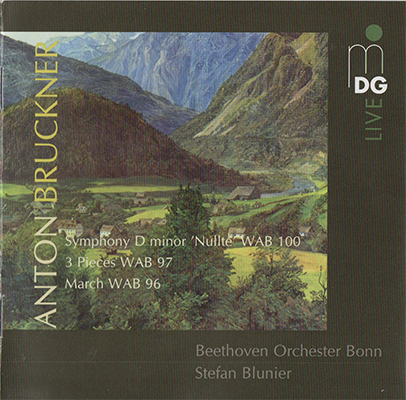
Beethoven Orchester Bonn, Stefan Blunier – Anton Bruckner – Symphony D minor “Nullte” WAB 100, 3 Pieces WAB 97, March WAB 96 (2011) [SACD / MDG – MDG 937 1673-6]

Beethoven Orchester Bonn, Stefan Blunier - Anton Bruckner - Symphony D minor “Nullte” WAB 100, 3 Pieces WAB 97, March WAB 96 (2011)

Title: Beethoven Orchester Bonn, Stefan Blunier – Anton Bruckner – Symphony D minor “Nullte” WAB 100, 3 Pieces WAB 97, March WAB 96 (2011)
Genre: Classical
Format: MCH SACD ISO + Hi-Res FLAC

This is a new recording of Bruckner’s ubiquitously numbered “0” symphony which is a fine work in its own right. Bernard Haitink included the work in his cycle of symphonies for Philips and Sir Georg Solti also recorded a fine interpretation with the Chicago Symphony Orchestra some years back. Stefan Blunier and his Bonn Orchestra are quite the real deal, having recorded various romantic symphonic works for the German label, MD&G. They play with an unabashed know-how of the music lending brazen authority to the loud fanfares which Bruckner integrates into the symphony. The opening Allegro is particularly enthusing while the Finale is also taken at a rather brisk pace with great momentum. All in all this is a pleasing performance of this symphony which is well worth investigating. The disc also includes some fine rarities in the form of a March in D minor and Three Pieces lasting around eight minutes. These are winningly done by the Beethoven Orchestra Bonn and are almost worth the price of the disc alone. An excellent recording and fastidiously detailed notes make up a package which is surely well worth investigating on all counts. Copyright © 2011, Gerald Fenech classical.net

This SACD is an essential purchase for Bruckner aficionados, as not only does it contain an eloquent performance of Bruckner’s early D minor Symphony WAB 100 (Nullte) in superb sound, but also some other rare orchestral music by the same composer. Though written in 1869 after both his ‘official’ Symphony No.1 in C minor and the even earlier Study Symphony in F minor, the composer, displaying his usual lack of confidence in his compositions, declared the work ‘not worthy’ so it was never assigned a number by him. Fortunately he did not destroy the score, but eventually willed it to the Linz Regional Museum and it received its first performance in 1924. Nowadays it is usually referred to as Symphony 0 whilst the Study Symphony is called Symphony 00. Peculiar as this numbering may seem, it does keep the symphonies in the correct chronological order. The thematic catalogue of Bruckner’s music, ‘Werkverzeichnis Anton Bruckners’ (WAB), attempts to clarify this even further, and in the case of the symphonies the WAB number is 100+ the published number. This symphony is such an immediately attractive work that its neglect in the concert hall is to be regretted, and, with the benefit of hindsight, one wishes that it had taken its rightful place in the canon of the composer’s numbered symphonies. Fortunately its dissemination on record has been more successful and many conductors with a special affinity to Bruckner’s music have committed it to disc. These include fine performances from Haitink, Barenboim and Skrowaczewski to which this distinguished account can now be added. Having been mightily impressed with Stefan Blunier’s expansive performance of Franz Schmidt’s 4th Symphony /showreviews/6576#7259 I was eager to hear how his Bruckner would sound, and was not disappointed. In the earlier recording Blunier showed that he was adept at sustaining the natural unfolding of a symphonic work over a long span, and once again this proves to be the case. The heavy tramp of the lower strings with which the first movement begins will, even to the innocent ear, immediately suggest Bruckner as the composer, while the gentler theme that follows will surely confirm it. Blunier handles the rapidly changing moods of this movement with great skill. His tempi are generally very measured, allowing the climaxes to build thrillingly with notably rich string tone and magnificently played brass chorales. The serene slow movement flows at a commodious tempo, certainly much closer to ‘Adagio’ than ‘Andante’, but thanks to the exquisite and totally committed playing that the conductor elicits from his fine Bonn orchestra it just about convinces, though perhaps his pause of a full 14 seconds silence towards the end of this movement may be too much for some listeners to take. The Scherzo is launched with tremendous energy and verve making the contrast with the preceding movement’s mood even greater. The Finale, that surprisingly contains passages reminiscent of Mendelssohn, is also played with great vigour and Bruckner’s contrapuntal writing emerges with both strength and clarity. At 50’11” Blunier’s performance lasts about five minutes longer than the average time of other versions and some may feel that he tries to inflate this music to something beyond its worth, but for this listener his spacious interpretation was entirely convincing and gave the music a stature entirely lacking in, for example, Solti’s CD recording that dispatched the piece in a mere 38’ 13”! The four brief fill-ups to the symphony date from 1862 and represent some of Bruckner’s earliest orchestral writing. Though not especially memorable or representative of the composer’s later music they do possess a winning fluency and are worth hearing for their pointers to the composer’s development. The jaunty five-minute D minor March (WAB 96) has a robust charm, while a gentle lilting central section provides contrast before the reprise of the march. Each of the three pieces (WAB97) that follow is even briefer. The nobility and grandeur of the E flat Moderato is followed by two wistful Andantes, the first of which feature lovely solos for oboe and horn. All four pieces could be easily mistaken for the Schubert of the early symphonies or ‘Rosamunde’, but their excessive brevity will always make them little more than a curiosity. MDG’s multi-channel recording is very fine indeed. It has a wide dynamic range and captures both the orchestra’s hushed string playing and incisive brass with equal success in an airy and generous acoustic. Though these are live performances (from 25-27 May 2010) there is neither audience noise nor applause. Strongly recommended. Copyright © 2011 Graham Williams and SA-CD.net

(more…)

6 min read