Claudio Chiara and Emanuele Cisi – People Time (2020) [Japan 2021] [SACD / Venus Records – VHGD-364]

Claudio Chiara and Emanuele Cisi - People Time (2020) [Japan 2021]

Title: Claudio Chiara and Emanuele Cisi – People Time (2020) [Japan 2021]
Genre: Jazz
Format: SACD ISO + DSF DSD64 + Hi-Res FLAC

A beautiful and thrilling Italian jazz ballad session by alto saxophone player Claudio Chiara and tenor saxophone player Emanuele Sisi. A quartet and quintet performance with the two frontmen Claudio Chiara and Emanuele Sissi, plus the piano trio of Massimo Faraò/Nicola Barbon/Bobo Facchinetti. Recorded in February 2020 in Turin, Italy.

(more…)

1 min read

Claudio Abbado, Wiener Philharmoniker – Brahms: 21 Ungarische Tänze – Hungarian Dances (1983) [Japan 2019] [SACD / Esoteric Company – ESSG-90200]

Claudio Abbado, Wiener Philharmoniker - Brahms: 21 Ungarische Tänze - Hungarian Dances (1983) [Japan 2019]

Title: Claudio Abbado, Wiener Philharmoniker – Brahms: 21 Ungarische Tänze – Hungarian Dances (1983) [Japan 2019]
Genre: Classical
Format: SACD ISO + Hi-Res FLAC

At their best, and especially on home ground in central European repertory, Abbado and the Vienna Philharmonic could produce electrifying music-making, as on the present recording of Brahms’s Hungarian Dances made in Vienna’s Sofiensaal in 1982. The recording was commissioned as part of Deutsche Grammophon’s superb 8-volume, 62-LP “Brahms Edition”, a survey of the composer’s complete musical output which was released in 1983 to mark the 150th anniversary of Brahms’s birth. Gramophone magazine’s Robert Layton commended the warmth, eloquence and virtuosity of the Vienna Philharmonic’s playing, adding that, though Abbado was scrupulous in his observation of the letter of the score, “the spirit of what Brahms liked to refer to as his ‘genuine gypsy children’ is always in evidence”.

Johannes Brahms was 17 when he encountered the brilliant young Hungarian violinist Ede Reményi in Hamburg in 1850. Reményi was passing through the city to the United States after being deported from Hungary for his involvement in the 1848 uprising against the Austrians. Brahms was intoxicated by Reményi’s transcriptions of gypsy and Magyar folk songs and dan¬ces, a fascination that deepened in 1852 when the two men toured together. The two sets of Hungarian Dances which Brahms later published were not the only fruits of the experience. Throughout a composing career that spanned more then 40 years, Hungarian influences were never far from his music. Brahms wrote his Hungarian Dances for piano duet. Books 1 and 2 (nos. 1-10) were pub-lished in 1869, Books 3 and 4 in 1880. The 1880 set offers what might best be called original compositions in the Hungarian style rather than free arrangements of the kind of Reményi-derived material which Brahms had once taken to be authentic. The 1880 set was never quite as popular as the 1869, perhaps because Brahms was no longer interested in the previously all-pervasive csárdás. Yet such is the craftsmanship of the later dances, it is they, paradoxically, which have the stronger “gypsy” feel. The later set did have one admirer: Antonín Dvořák, who provided orchestrations of the last four dances, nos. 17-21.

(more…)

2 min read

Claudio Abbado, Chamber Orchestra Of Europe – Mozart: Don Giovanni (1998) [Reissue 2004] [SACD / Deutsche Grammophon – 00289 474 9962 GSA3]

Claudio Abbado, Chamber Orchestra Of Europe - Mozart: Don Giovanni (1998) [Reissue 2004]

Title: Claudio Abbado, Chamber Orchestra Of Europe – Mozart: Don Giovanni (1998) [Reissue 2004]
Genre: Classical
Format: MCH SACD ISO + Hi-Res FLAC

Arguably the greatest opera ever written, the Mozart/Da Ponte depiction of the last twenty-four hours of the legendary libertine is performed here in the standard version combining the two versions Mozart prepared. Abbado offers modern instruments with certain nods to period performance practice–many appoggiaturas, comparatively fleet tempos, and some modest ornamentation.

This new Don Giovanni with Claudio Abbado conducting the Chamber Orchestra of Europe is Abbado’s second recording of a Mozart opera for Deutsche Grammophon. It was made in Ferrara in conjunction with performances of the opera early in 1997 with the Chamber Orchestra of Europe. The cast features Bryn Terfel in one of his most famous stage roles as Leporello, singing alongside the young British baritone Simon Keenlyside as Don Giovanni. Terfel made his role debut as Leporello in the Patrice Chereau production of the opera in Salzburg. The Welsh singer’s performances of Leporello, together with Figaro, have been repeated highlights of the Salzburg Festival since then. No single adjective can encapsulate the power of Terfel’s stage presence in these roles. In addition to perfect singing and impeccable Italian in the recitatives, he brings the role of Leporello an ambiguous and sometimes menacing energy which threatens to subvert the traditional presuppositions of the master-servant relation. The cast is stronger on the male side but there are no weak links. The three baritones are especially strong. Keenlyside offers a sexy, dangerous Don. Terfel, completing his traversal of the three baritone roles, is a saturnine, bitter Leporello while D’Arcangelo is a Masetto to be reckoned with. Heilmann offers a sweet-toned Ottavio who nevertheless cannot manage the famous run without a breath. Salminen is a cavernous Commendatore. The women reverse the usual casting of Anna and Elvira, with Anna possessing the lighter voice. Isokowski is a powerful Elvira, a woman to be taken very seriously. Once the ear adjusts to the lack of steel, Reminfio is a fine Anna, like Callas and Moser phrasing the reprise of “Non mi dir” in a single span. Pace is a conventional Zerlina countering the recent trend to cast her as a mezzo.

(more…)

2 min read

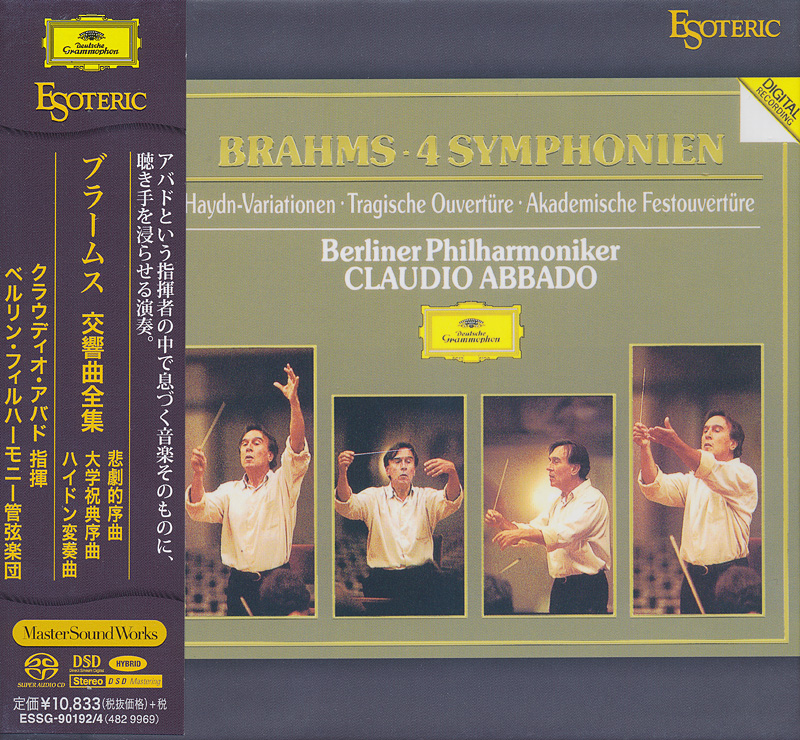
Claudio Abbado, Berliner Philharmoniker – Brahms: The 4 Symphonies (Esoteric Japan 2018) [SACD / Esoteric Company – ESSG-90192/4]

Claudio Abbado, Berliner Philharmoniker - Brahms: The 4 Symphonies (Esoteric Japan 2018)

Title: Claudio Abbado, Berliner Philharmoniker – Brahms: The 4 Symphonies (Esoteric Japan 2018)
Genre: Classical
Format: SACD ISO + DSF DSD64 + Hi-Res FLAC

For collectors of Claudio Abbado’s recordings, the performances on this three-discs Japanese Esoteric label’s remastered release of the Italian conductor’s digital recordings of Brahms’ symphonies with the Berliner Philharmoniker may seem redundant, since the symphonies were previously released as single discs in the late ’80s and early ’90s on Deutsche Grammophon. But this box set marks the first hybrid SACD release of historical recording selections. These new audio versions feature Esoteric’s proprietary re-mastering process to achieve the highest level of sound quality.

These performances are technically impeccable; Abbado is a tremendously skillful conductor who knows these scores like the back of his hand, and the Berliner Philharmoniker is one of the two or three finest orchestras in Europe, with a collective virtuosity that no other orchestra on the planet can match. The performances are also interpretively irreproachable. Some might find Abbado a bit stiff – there’s no tempo bending here – but even they would have to admit that there is nothing in Abbado’s accounts that does not come directly out of the score: his First’s resolute heroism, his Second’s dappled lyricism, his Third’s sensual romanticism, and his Fourth’s unrelenting tragedy are all rooted in the music, not in Abbado’s personal psychology. This set is additionally worthwhile because the single-movement works are as well-played and interpreted as the symphonies, particularly the choral works Nänie and Gesang der Parzen. Deutsche Grammophon’s digital sound was crisp, clear, and vivid, and Musical Heritage Society’s reissues are identical. If you’re looking for a single set of digitally recorded Brahms orchestral works, this set cannot be bettered.

(more…)

2 min read

Claude Williamson Trio – South Of The Border West Of The Sun (1993) [Japan 2017] [SACD / Venus Records – VHGD-215]

Claude Williamson Trio - South Of The Border West Of The Sun (1993) [Japan 2017]

Title: Claude Williamson Trio – South Of The Border West Of The Sun (1993) [Japan 2017]
Genre: Jazz
Format: SACD ISO + DSF DSD64 + Hi-Res FLAC

Claude Berkeley Williamson was an American jazz pianist. In 1968, he started working as a pianist for NBC, first on The Andy Williams Show, then for Sonny and Cher. In 1978, Williamson went back to the jazz world and released many albums, mainly for Japanese labels. On this release for Venus Records he is joined by Andy Simpkins (bass) and Al “Tootie” Heath (drums).

(more…)

1 min read

Claude Williamson Trio – Song For My Father (2001) [Japan 2018] [SACD / Venus Records – VHGD-269]

Claude Williamson Trio - Song For My Father (2001) [Japan 2018]

Title: Claude Williamson Trio – Song For My Father (2001) [Japan 2018]
Genre: Jazz
Format: SACD ISO + Hi-Res FLAC

American jazz pianist Claude Williamson, although born in Vermont, moved to California early in his career and worked with West Coast jazz heavyweights Art Pepper, Max Roach, Bud Shank and Stan Levey. Williamson also spent a portion of his career in television, starting in the late 1960s, including stints with both The Andy Williams Show and Sonny and Cher. For this 2002 Venus release he is joined by Andy Simpkins (bass) and Al “Tootie” Heath (drums).

(more…)

1 min read

Claude Williamson Trio – El Noche De Espana (1994) [Japan 2019] [SACD / Venus Records – VHGD-341]

Claude Williamson Trio - El Noche De Espana (1994) [Japan 2019]

Title: Claude Williamson Trio – El Noche De Espana (1994) [Japan 2019]
Genre: Jazz
Format: SACD ISO + DSF DSD64 + Hi-Res FLAC

Claude Williamson was an American jazz pianist who studied at the New England Conservatory of Music before moving to jazz, influenced mainly by Teddy Wilson, then by Al Haig and Bud Powell. He worked with Max Roach, Art Pepper and others. Williamson was a longtime member of the Lighthouse All-Stars (substituting for pianist Russ Freeman), performing with Bud Shank, Stan Levey, Bob Cooper, Conte Candoli and Howard Rumsey. This release was recorded in Hollywood for Japanese Venus label.

(more…)

1 min read

Anette Maiburg , Alexandra Carvero , Emmanuel Ceysson , Wen Xiao Zheng – Classica Francese (2013) [SACD / MDG – MDG 910 1825-6]

Anette Maiburg , Alexandra Carvero , Emmanuel Ceysson , Wen Xiao Zheng - Classica Francese (2013)

Title: Anette Maiburg , Alexandra Carvero , Emmanuel Ceysson , Wen Xiao Zheng – Classica Francese (2013)
Genre: Classical
Format: MCH SACD ISO + Hi-Res FLAC

Yves Montand and Claude Debussy, Jacques Brel and André Jolivet -Anette Maiburg is taking us on another conducted tour, bringing musical worlds together.
“Classica francese” gives the enterprising and exceptional flautist the opportunity to show us that high-calibre chamber music and deeply expressive chansons need not be worlds apart. She is joined by Alexandra Cravero, whose remarkably flexible voice leaves these well-known songs haunting us, and Emmanuel Ceysson, whose sensitive harp playing has delighted audiences and reviewers alike. prestoclassical Viele der sogenannten „Crossover“-Experimente der letzten Jahre und Jahrzehnte hinterließen einen zwiespältigen Eindruck, vor allem wohl, weil meist so getan wurde, als ob alle Musikformen, jene der Kunstmusik und jene der Populärkultur, irgendwie gleichwertig wären. Interessanterweise unterscheidet auch Anette Maiburg, der spiritus rector dieses Albums „Classica francese“, in ihrem Beihefttext zwischen „klassischer Ausbildung“ und „anderen Musikstilen“: Auf dieser fünften Folge einer Reihe von nationalstilistischen CD-Programmen (es gibt auch „Classica Cubana“ und anderes) stehen französische Chansons besonders der 1950er und 60er Jahre den vier Kunstkompositionen von Debussy, Jolivet und Jean Cras gegenüber. Das Nebeneinander von Chanson und klassischer Kammermusik erweist sich hier jedoch als harmonisch. Dies liegt daran, dass sowohl die Komponisten Debussy, Jolivet und Cras auf je eigene Weise auch auf die Popularmusik ihrer Zeit anspielten, die sehr guten Arrangements der Chansons für das siebenköpfige Kammerensemble von Andreas N. Tarkmann aber ihrerseits starke Anleihen an klassischer Instrumentationskunst machen. Schön etwa die vereinzelten Tupfer von Harfe und Xylophon in „Elle fréquentait la rue Pigalle“, das durch die Piaf berühmt wurde, oder „Ces gens là“ von Jaques Brel, dessen Besetzung lange sehr reduziert gehalten wird. Alexandra Cravero singt diese Chansons, die von der Authentizität der Passionen leben, schlichtweg wundervoll. Zwischen den Kompositionen und den Chansons treten die Qualitätsbrüche aber auch deswegen nicht störend hervor, weil die sieben Musiker um die Flötistin Anette Maiburg alle Stücke mit einer begeisternden Sensibilität spielen. Die sieben Solisten sind sämtlich bereit, gleichsam auch ihrem eigenen Klang nachzulauschen sowie den zauberhaften Verbindungen, die dieser mit dem der anderen Instrumenten eingeht. So übertreffen die Musiker in Debussys Sonate für Flöte, Viola und Harfe sogar die bisherige Referenzaufnahme des Ensembles Wien-Berlin aus den späten achtziger Jahren (Deutsche Grammophon 429 738-2) an Raffinesse; die Sonate und auch das Prélude à l’après-midi d’un faune in einer kammermusikalischen Fassung werden mit einem akuten Sinn für deren klanglichen Wunder präsentiert. Den kompositorisch avanciertesten Akzent setzt Jolivets Chant de linos von 1945, der neben den magischen und den melancholischen Stimmungen auch ein wenig Dunkelheit hören läßt. Wenn ein Programm so ausgewogen zusammengestellt ist und so hochkonzentriert musiziert wird, dann läßt man sich „Crossover“ gerne gefallen. Nicht zuletzt auch wegen der glasklaren Akustik sehr hörenswert. 10/10 Michael B. Weiß Klassik Heute

(more…)

3 min read

Clark Terry & Max Roach – Friendship (2002) [Japan] [SACD / Eighty-Eight’s – VRGL 8805]

Clark Terry & Max Roach - Friendship (2002) [Japan]

Title: Clark Terry & Max Roach – Friendship (2002) [Japan]
Genre: Jazz
Format: SACD ISO + Hi-Res FLAC

Friendship is a very special album Clark Terry and Max Roach recorded together in 2002. At that time, Terry was 82 years old and Roach 78, and as it turned out to be one of the last recordings Roach made before passing in 2007. The bulk of this unique album consists of six duo performances by the two principals, two solo performance by Terry, one solo performance by Roach, and the remaining four are trio and quartet performances with pianist Don Friedman and bassist Marcus McLaurine.

Friendship is a recording of fresh, swinging music with broad but intelligent appeal to committed Terry or Roach fans as well as new listeners just coming to an appreciation of these great musicians. Clark Terry demonstrates the flawless technique, buttery sound, and elegant, good-natured, witty improvisation for which he is famous. Roach offers, as always, a powerful conception of the drums, using a wide and creative sound palette. His approach on this recording is so unassuming that it is easy to lose sight of how complete his playing is in itself. “Lil’ Max,” for example, is a musical whole. It takes a bit of attention to realize that it is also an unaccompanied drum solo. Both Don Friedman and the inexplicably under-recognized Marcus McLaurine have long been associated with Terry. Everyone sounds comfortable with themselves, each other, and the straightforward, but demanding quartet setting. Friendship also has an eclectic side. The album begins with “Statements,” a free jazz duet between the co-leaders. The set includes Monk’s “Let’s Cool One” and the standards “But Beautiful,” “When I Fall in Love,” “Makin’ Whoopee,” “The Nearness of You,” and “I Remember Clifford.” By continuing to perform at this level, Terry and Roach, who for decades have had nothing to prove to anyone, not only enrich us musically yet again—they also teach important lessons about artistic integrity. We are lucky to have their example.

(more…)

2 min read

Clark Tracey – Stability (2001) [Reissue 2003] [SACD / Linn Records – AKD 196]

Clark Tracey - Stability (2001) [Reissue 2003]

Title: Clark Tracey – Stability (2001) [Reissue 2003]
Genre: Jazz
Format: SACD ISO + Hi-Res FLAC

Clark Tracey has gathered a group of top-of-the-list UK jazz artists for a session that incorporates hard bop, some smooth jazz, and pretty ballads with a string quartet in attendance. For his debut solo album drummer Clark Tracey has brought together a range of musicians, each hand-picked as a result of who he thought best suited the mood of each piece. With connections borne of years in the industry Clark was able to have his first choice of performer on each instrument resulting in unbeatable interpretations. The guests musicians include Andy Sheppard, Tommy Smith, Tim Garland, Iain Ballamy, Nigel Hitchcock, Guy Barker, Christine Tobin, Gareth Williams, Arnie Somogyi, Laurence Cottle and the Locrian String Quartet.

Scion of foremost English jazz pianist Stan Tracey, drummer Clark Tracey has gathered a group of top-of-the-list U.K. jazz artists for a session that incorporates a variety of playing modes, including a contribution by Irish avant-garde singer Christine Tobin. There’s hard bop, some smooth jazz, and pretty ballads with a string quartet in attendance. Tracey has found a successful and accommodating method to solve the conundrum drummer leaders often find themselves faced with, viz., to dominate and run the risk of overwhelming or to lie back and be the main rhythm. He provides rhythmic support, adding well-timed drum breaks and short but telling solos. The drummer adopts a broad definition for “support.” Tracey is quite active on such cuts as “Giant Steps,” where he and pianist Gareth Williams offer a much more straight swinging version of John Coltrane’s classic than usually heard, likely because of the strong involvement of Tracey’s drums. On tunes as “Black Coffee”,,the drummer lays back as Tim Garland’s sax takes the lead with the Locrian String Quartet on hand to provide the bulk of the musical background. Tracey also contributes well conceived, melodic originals such as “Lounge Blues,” a tune that exudes an exotic aura which Iain Ballamy’s soprano sax helps create with Tracey’s cymbals and Arnie Somogyi’s bass. Irish singer Christine Tobin provides a vocal recitation of the moving poetic lyrics for Tracey’s “Stability.” The lieder recital mood is set by the Locrian String Quartet, the only instrumentation on the track. One of the more intriguing cuts is a pensive piano solo by Tracey, giving a rare airing of Duke Ellington’s “Melancholia.” Stability is a seminar on eclectic musical styles and is recommended.

(more…)

3 min read