Erich Kunzel & Cincinnati Pops Orchestra – On Broadway (1999) [SACD / Telarc – CD-60498-SA]

Erich Kunzel & Cincinnati Pops Orchestra - On Broadway (1999)

Title: Erich Kunzel & Cincinnati Pops Orchestra – On Broadway (1999)
Genre: Soundtrack
Format: SACD ISO + Hi-Res FLAC

The Cincinnati Pops is one of America’s favorite orchestras, playing classical hits, orchestral versions of pop and jazz, movie themes and show tunes. On Broadway features Erich Kunzel and the Cincinnati Pops Orchestra’s typically robust readings of favorites from the Great White Way: focusing primarily on latter-day stage hits, the collection includes rousing renditions of “He Lives in You,” “Seasons of Love,” “This Is the Moment,” “Cross the Line,” and “Hookers’ Ball. .

(more…)

1 min read

Erich Kunzel & Cincinnati Pops Orchestra – Mega Movies (2000) [Reissue 2006] [SACD / Telarc – SACD-60535]

Erich Kunzel & Cincinnati Pops Orchestra - Mega Movies (2000) [Reissue 2006]

Title: Erich Kunzel & Cincinnati Pops Orchestra – Mega Movies (2000) [Reissue 2006]
Genre: Soundtrack
Format: MCH SACD ISO + Hi-Res FLAC

The Cincinnati Pops is one of America’s favorite orchestras, playing classical hits, orchestral versions of pop and jazz, movie themes and show tunes. In the main, this is a collection of film music resembling others by Erich Kunzel and the indefatigable Cincinnati Pops, featuring short excerpts from film scores like those to Star Wars: The Phantom Menace, The Rock, Godzilla, and Titanic. Kunzel’s performances are brisk, a bit subdued compared to those in the original films, technically faultless, and carefully consistent. Anyone who has enjoyed other Kunzel discs will enjoy this one, but this is a film-music disc with a difference: there are five tracks of sound effects included. These are quite short, but they’re well worth hearing. For one thing, they’ll give a full workout even to stereo equipment costing thousands of dollars. The booklet contains various disingenuous warnings about not turning up the volume too high while playing these, but they are in no way oversold. What’s remarkable about them is that for the most part they don’t rely on synthetic sound synthesis. The bee attack in The X-Files: The Movie was recorded by engineer Michael Bishop in a field, with six microphones placed at the entrances of a beehive. It’s uncanny. This may be the only audiophile album in existence whose credits thank a beekeepers’ association. The sound, auditioned on a good conventional stereo, is the main attraction here, and those with the equipment to take full advantage of the glories only hinted out by mere mortals among sound reproduction systems ought to be fully satisfied.

(more…)

2 min read

Erich Kunzel & Cincinnati Pops Orchestra – Got Swing! (2003) [SACD / Telarc Surround – SACD-60592]

Erich Kunzel & Cincinnati Pops Orchestra - Got Swing! (2003)

Title: Erich Kunzel & Cincinnati Pops Orchestra – Got Swing! (2003)
Genre: Jazz
Format: MCH SACD ISO + Hi-Res FLAC

The Cincinnati Pops is one of America’s favorite orchestras, playing classical hits, orchestral versions of pop and jazz, movie themes and show tunes… This is a good, solid pops recording; a disc that’s fun to hear. It’s not necessarily for hardcore jazzheads or swing dancers, but might be just the thing to introduce some of these classic tunes to folks who think they don’t like jazz. Most of these tracks don’t swing hard, but there are a few that even a dedicated dancer would want to try out.

Some real standards of the original swing era are presented here, hot and sweet. “Swingin’ at the Savoy” (this referring to the great Savoy Ballroom of Harlem), “Straighten Up and Fly Right,” “Avalon,” “It Don’t Mean a Thing,” “I’ll Be Seeing You,” and “Flying Home” (Lionel Hampton’s most famous creation) are just a few examples. Many of these songs have great stories behind their creation or earliest recordings. If you don’t love swing already, they’ll start you on your way. A few have been arranged until their original character is somewhat obscured (“Blues in the Night” now sounds like something from a Rodgers & Hammerstein musical); but the mix is excellent, and the musicians even better, whether the prevailing sound is pops-oriented or swinging. John Pizzarelli gives particularly standout performances on guitar and vocally. His clever manipulations of music and words mark some of the really swinging tracks. “Avalon” is a great hot take. Pizzarelli, son of jazz guitarist Bucky Pizzarelli, is in good company. Other guest artists include the vocalise group the Manhattan Transfer in various guises, from the ensemble to solo voice and rhythm section. Got Swing! is an excellent example of why pops orchestras continue to flourish (they’re just fun) and it’s liable to make the listener want to go out one night and see Erich Kunzel and the Cincinnati Pops live.

(more…)

2 min read

Erich Kunzel, Cincinnati Pops Orchestra – Vintage Cinema (2008) [SACD / Telarc – SACD-60708]

Erich Kunzel, Cincinnati Pops Orchestra - Vintage Cinema (2008)

Title: Erich Kunzel, Cincinnati Pops Orchestra – Vintage Cinema (2008)
Genre: Soundtrack
Format: MCH SACD ISO

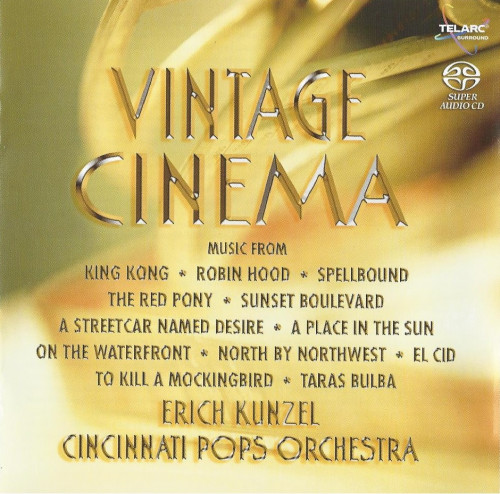
This disc showcases developing musical styles used in films spanning nearly 30 years, beginning with Max Steiner’s theme to the original King Kong (1933) and moving on to merry old England for Eric Wolfgang Korngold’s theme to the spectacular 1938 film, The Adventures of Robin Hood. Alfred Hitchcock understood the vital role music plays in film. Miklós Rózsa’s suite from the 1945 thriller Spellbound captures the psychological suspense with the unique timbre of a theremin – Rózsa won his first Oscar for this score. Legendary film composer Bernard Herrmann’s overture to Hitchcock’s “wrong man” thriller, North by Northwest (1959) is next in the tracklist. Aaron Copland lent his considerable talents to Hollywood on several occasions, including the 1947 screen adaptation of John Steinbeck’s The Red Pony, selections from the folk-like score are included here. Two Oscar-winning scores by Franz Waxman, one from Billy Wilder’s 1950 classic Sunset Boulevard, as well as A Place in the Sun the following year, deliver quintessential 50’s film music. Next is Alex North’s New Orleans-spiced 1951 score for A Streetcar Named Desire, the first important Hollywood score to incorporate jazz. The great Leonard Bernstein scored only one film, but On the Waterfront (1954) is widely regarded as cinematic classic. ‘Vintage Cinema’ then turns to the 1960s in its three final tracks: Rózsa’s Spanish-flavoured overture to the lavish Charlton Heston epic, El Cid (1961), Elmer Bernstein’s main title theme from To Kill a Mockingbird (1962), and the rousing “Ride of the Cossacks” from Taras Bulba, a 1962 film scored again by the inimitable Franz Waxman.

(more…)

2 min read

Erich Kunzel, Cincinnati Pops Orchestra – Scary Music (2002) [SACD / Telarc Surround – SACD-60580]

Erich Kunzel, Cincinnati Pops Orchestra - Scary Music (2002)

Title: Erich Kunzel, Cincinnati Pops Orchestra – Scary Music (2002)
Genre: Soundtrack
Format: MCH SACD ISO

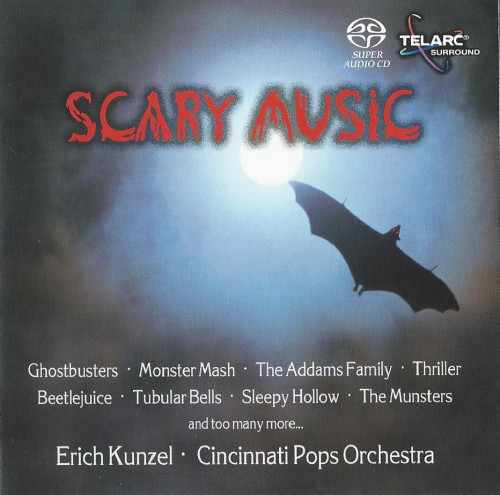
Telarc celebrates Halloween a few weeks early with the release of Scary Music, the highly anticipated follow-up to conductor Erich Kunzel and the Cincinnati Pops Orchestra’s Chiller recording. This imaginative gathering of haunted pop favourites is sure to send a shiver down the spine. Scary Music features an eerie collection of sound effects and frighteningly memorable performances of theme music from such well-known Hollywood horror films as Ghostbusters, The Blob, Attack of the Killer Tomatoes, The Nightmare Before Christmas, Beetlejuice, The Haunting, Sleepy Hollow and The Shining. Also included are themes from television series Tales from the Crypt, Dark Shadows, The Munsters, and Addams Family. Popular songs provide yet another source for Scary Music. Two of the biggest singles of the early 1960s were one-hit wonders: the Ran-Dells’ “Martian Hop” and Bobby Pickett’s “Monster Mash”. Chilling pop music of a different sort is represented by Rod Temperton’s title song for Michael Jackson’s Thriller, the best-selling album of all time, and Michael Oldfield’s “Tubular Bells”, which was used in the movie The Exorcist.

“There is probably something fundamental in a good vicarious scare: more than simply being fun, it also allows us to experience emotions that heighten our awareness of some deep unspoken plane of our common humanity.” – Richard E. Rodda, in the liner notes

(more…)

2 min read

Eric Heidsieck, André Vandernoot – Mozart: Piano Concertos Nos. 20, 21, 23, 24, 25 & 27 [3 SACDs] (2018) [SACD / Warner Classics – TDSA-77/9]

Eric Heidsieck, André Vandernoot - Mozart: Piano Concertos Nos. 20, 21, 23, 24, 25 & 27 [3 SACDs] (1957-1960/2018)

Title: Eric Heidsieck, André Vandernoot – Mozart: Piano Concertos Nos. 20, 21, 23, 24, 25 & 27 [3 SACDs] (1957-1960/2018)
Genre: Classical
Format: SACD ISO

Hyde-Seck’s celebrated recording from his youth returns in majestic style! This world-first SACD release captures a masterful performance where freedom and musicality blend in perfect harmony. The 24th returns for the first time since its LP release! To mark the 50th anniversary of his first Japan tour, we present a 3-disc SACD hybrid set of Eric Heidsieck’s youthful ‘Mozart: Piano Concertos’. Even amongst the vast number of Mozart recordings, this collection not only retains its lustre but continues to be cherished by many. This year (2018), coinciding with his Japan tour featuring a programme including part of Concerto No. 21, we are reissuing a limited set of six concertos from his early career, originally recorded for EMI. Among these six, the four stereo recordings in particular are exceptionally rare, cherished by many devoted fans who still consider them unrivalled. Recording began in December 1957 with the 24th, alongside the 21st. Work resumed in June 1960 for the 20th and 23rd, followed by the 25th in September 1961, with the 27th concluding the series, all captured by EMI France at the time. Hyde-Seck (1936-), one of Cortot’s (1877-1962) beloved pupils, was just 21 years old at the time of the first recording. He graduated from the Paris Conservatoire National Supérieur de Musique in 1954 and made his French debut the following year. His talent was recognised early in Paris, and he made his American debut in 1960. The first two recordings, being monaural, were slow to be reissued in the CD era (No. 21 was first released on CD in January 2006 on a Tower Records compilation; No. 24 remains unreleased on CD to date). However, the four stereo recordings, regarded as among the definitive performances of these works, were frequently reissued on budget labels, reaching a wide audience. While Mozart performances are not bound by a single mould, one is immediately struck by the improvisational quality and thrilling energy of Heidscheck’s piano, which moves with boundless freedom. At the same time, the flexibility of its sound and its refined expression are nothing short of genius. The performance is emotive yet meticulously detailed, a miraculous achievement that continues to garner enduring support. Equally unforgettable is the meticulously considered accompaniment from the Orchestre du Conservatoire de Paris and Vanderノート, whose contribution is so vital that without this partnership, the performance would scarcely merit the title of ‘masterful’. There is not a trace of emotional indulgence here; instead, one glimpses the unshakeable resolve to support this young pianist wholeheartedly. Recorded during sessions at Salle Wagram, these sources fully capture the orchestra’s sound of the era, with the woodwind tones being particularly exquisite. The freshness of this reissue allows one to savour Hidetsugu’s delicate touch, the contrast with the backing, and Vandernoot’s subtle expression even more fully. The SACD layer offers an even higher resolution to enjoy this century’s masterpiece. For this reissue, masters digitally transferred at 96kHz/24bit from the original domestic masters were used, with separate mastering undertaken anew for the SACD layer and the CD layer. This is a permanent preservation edition.

This time, we have also reinstated the commentary by Mr Kōhō Uno, a central devotee of Hydeschek featured in previous editions, alongside a new foreword by Mr Hiro Aiba. The commentary, which also considers Hydeschek’s current status, is particularly noteworthy. For this series, the SACD layer aims for extended high frequencies and soft nuances alongside high resolution and a rich soundstage, while the CD layer strives for a cohesive, solid sound with a tangible, present-to-the-touch timbre. The CD itself possesses considerable potential; indeed, we invite you to enjoy it as an SACD hybrid disc, allowing you to savour the best of both formats.

(more…)

4 min read

Eric Dolphy – At The Five Spot, Vol.1 (1961) [APO Remaster 2018] [SACD / Analogue Productions – CPRJ 8260 SA]

Eric Dolphy - At The Five Spot, Vol.1 (1961) [APO Remaster 2018]

Title: Eric Dolphy – At The Five Spot, Vol.1 (1961) [APO Remaster 2018]
Genre: Jazz
Format: SACD ISO + Hi-Res FLAC

After having left the ensemble of Charles Mingus and upon working with John Coltrane, Eric Dolphy formed a short-lived but potent quintet with trumpeter Booker Little, who would pass away three months after this recording. Despite all of the obstacles and subsequent tragedy, this quintet became legendary over the years – justifiably so – and developed into a role model for all progressive jazz combos to come. The combined power of Dolphy and Little – exploring overt but in retrospect not excessive dissonance and atonality – made them a target for critics but admired among the burgeoning progressive post-bop scene. With the always stunning shadings of pianist Mal Waldron, the classical-cum-daring bass playing of Richard Davis, and the colorful drumming of alchemistic Ed Blackwell, there was no stopping this group.

Live at the legendary Five Spot Café in New York City, this band set the Apple, and the entire jazz world on their collective ears. “Fire Waltz” demonstrates perfectly how the bonfire burns from inside the soul of these five brilliant provocateurs, as Dolphy’s sour alto and Little’s dour trumpet signify their new thing. Dolphy’s solo is positively furious, while Blackwell nimbly switches up sounds within the steady 3/4 beat. “Bee Vamp” does not buzz so much as it roars in hard bop trim. A heavy tandem line breaks and separates in the horn parts like booster rockets. Blackwell is even more amazing, and Dolphy’s ribald bass clarinet set standards that still influences players of the instrument. Where “The Prophet” is a puckery blues, it is also open armed with minor phrasings and stretched harmonics. This is where Waldron and Davis shine in their terra cotta facades of roughly hewn accompaniments to Dolphy and Little’s bold flavored statements. A shorter alternate take of “Bee Vamp” is newly available, shorter by two-and-a-half minutes and with a clipped introductory melody. Most hail this first volume, and a second companion album from the same sessions, as music that changed the jazz world as much as Ornette Coleman and John Coltrane’s innovative excursions of the same era. All forward thinking and challenged listeners need to own these epic club dates.

(more…)

2 min read

Eric Dolphy – Out There (1960) [Reissue 2003] [SACD / New Jazz – NJSA-8252-6]

Eric Dolphy - Out There (1960) [Reissue 2003]

Title: Eric Dolphy – Out There (1960) [Reissue 2003]
Genre: Jazz
Format: SACD ISO + Hi-Res FLAC

The follow-up album to Outward Bound, Eric Dolphy’s second effort for the Prestige/New Jazz label (and later remastered by Rudy Van Gelder) was equally praised and vilified for many reasons. At a time when the “anti-jazz” tag was being tossed around, Dolphy’s nonlinear, harshly harmonic music gave some critics grist for the grinding mill. A second or third listen to Dolphy’s music reveals an unrepentant shadowy side, but also depth and purpose that were unprecedented and remain singularly unique. The usage of bassist George Duvivier and cellist Ron Carter (an idea borrowed from Dolphy’s days with Chico Hamilton) gives the music its overcast color base, in many ways equally stunning and uninviting. Dolphy’s ideas must be fully embraced, taken to heart, and accepted before listening. The music reveals the depth of his thought processes while also expressing his bare-bones sensitive and kind nature. The bluesy “Serene,” led by Carter alongside Dolphy’s bass clarinet, and the wondrous ballad “Sketch of Melba” provide the sweetest moments, the latter tune identified by the fluttery introspective flute of the leader, clearly indicating where latter-period musicians like James Newton initially heard what would form their concept. Three pieces owe alms to Charles Mingus: his dark, moody, doleful, melodic, and reluctant composition “Eclipse”; the co-written (with Dolphy) craggy and scattered title track featuring Dolphy’s emblematic alto held together by the unflappable swing of drummer Roy Haynes; and “The Baron,” the leader’s dark and dirty, wise and willful tribute to his former boss, accented by a choppy and chatty solo from Carter. “17 West,” almost a post-bop standard, is briefly tonal with a patented flute solo and questioning cello inserts, while the unexpected closer written by Hale Smith, “Feathers,” is a haunting, soulful ballad of regret where Dolphy’s alto is more immediately heard in the foreground. A somber and unusual album by the standards of any style of music, Out There explores Dolphy’s vision in approaching the concept of tonality in a way few others – before, concurrent, or after – have ever envisioned.

(more…)

2 min read