John Coltrane – Blue Train (1957) [Analogue Productions 2008] [SACD / Analogue Productions – CBNJ 81577 SA]

John Coltrane - Blue Train (1957) [Analogue Productions 2008]

Title: John Coltrane – Blue Train (1957) [Analogue Productions 2008]
Genre: Jazz
Format: SACD ISO + Hi-Res FLAC

Although never formally signed, an oral agreement between John Coltrane and Blue Note Records founder Alfred Lion was indeed honored on Blue Train — Coltrane’s only collection of sides as a principal artist for the venerable label. The disc is packed solid with sonic evidence of Coltrane’s innate leadership abilities. He not only addresses the tunes at hand, but also simultaneously reinvents himself as a multifaceted interpreter of both hard bop as well as sensitive balladry — touching upon all forms in between. The personnel on Blue Train is arguably as impressive as what they’re playing. Joining Coltrane (tenor sax) are Lee Morgan (trumpet), Curtis Fuller (trombone), Kenny Drew (piano), Paul Chambers (bass), and Philly Joe Jones (drums). The triple horn arrangements incorporate an additional sonic density that remains a trademark unique to both this band and album. Of particular note is Fuller’s even-toned trombone, which bops throughout the title track as well as the frenetic “Moments Notice.” Other solos include Paul Chambers’ subtly understated riffs on “Blue Train” as well as the high energy and impact from contributions by Lee Morgan and Kenny Drew during “Locomotion.” The track likewise features some brief but vital contributions from Philly Joe Jones — whose efforts throughout the record stand among his personal best. Of the five sides that comprise the original Blue Train, the Jerome Kern/Johnny Mercer ballad “I’m Old Fashioned” is the only standard; in terms of unadulterated sentiment, this version is arguably untouchable. Fuller’s rich tones and Drew’s tastefully executed solos cleanly wrap around Jones’ steadily languid rhythms. Without reservation, Blue Train can easily be considered in and among the most important and influential entries not only of John Coltrane’s career, but of the entire genre of jazz music as well.
https://www.discogs.com/release/3338194-John-Coltrane-Blue-Train

(more…)

2 min read

John Coltrane – A Love Supreme (1964) [Analogue Productions 2010] [SACD / Analogue Productions – CIPJ 77 SA]

John Coltrane - A Love Supreme (1964) [Analogue Productions 2010]

Title: John Coltrane – A Love Supreme (1964) [Analogue Productions 2010]
Genre: Jazz
Format: SACD ISO + Hi-Res FLAC

Easily one of the most important records ever made, John Coltrane’s A Love Supreme was his pinnacle studio outing that at once compiled all of his innovations from his past, spoke of his current deep spirituality, and also gave a glimpse into the next two and a half years (sadly, those would be his last). Recorded at the end of 1964, Trane’s classic quartet of Elvin Jones, McCoy Tyner, and Jimmy Garrison stepped into the studio and created one of the most thought-provoking, concise, and technically pleasing albums of their bountiful relationship (not to mention his best-selling to date). From the undulatory (and classic) bassline at the intro to the last breathy notes, Trane is at the peak of his logical yet emotionally varied soloing while the rest of the group is remarkably in tune with Coltrane’s spiritual vibe. Composed of four parts, each has a thematic progression leading to an understanding of spirituality through meditation. From the beginning, “Acknowledgement” is the awakening of sorts that trails off to the famous chanting of the theme at the end, which yields to the second act, “Resolution,” an amazingly beautiful piece about the fury of dedication to a new path of understanding. “Persuance” is a search for that understanding, and “Psalm” is the enlightenment. Although he is at times aggressive and atonal, this isn’t Trane at his most adventurous (pretty much everything recorded from here on out progressively becomes much more free, and live recordings from this period are extremely spirited), but it certainly is his best attempt at the realization of concept — as the spiritual journey is made amazingly clear. A Love Supreme clocks in at just over 30 minutes, but if it had been any longer it could have turned into a laborious listen. As it stands, just enough is conveyed. It is almost impossible to imagine a world without A Love Supreme having been made, and it is equally impossible to imagine any jazz collection without it.
https://www.discogs.com/release/3363851-John-Coltrane-A-Love-Supreme

(more…)

2 min read

John Barry – Frances (1982) [Reissue 2005] [SACD / Label X – LXSACD 1001]

John Barry - Frances (1982) [Reissue 2005]

Title: John Barry – Frances (1982) [Reissue 2005]
Genre: Soundtrack
Format: SACD ISO + Hi-Res FLAC

John Barry’s sensitive score to the 1982 biopic Frances harkens back to the Hollywood golden era that launched the film’s subject, doomed actress Frances Farmer (played onscreen by Jessica Lange). Its simple yet sumptuous melodies evoke the classic melodramas of decades past, albeit informed with an emotional depth rarely achieved in the infancy of the sound era. Barry captures the beauty and tragedy of both Farmer and Lange, creating slow-burning themes that brilliantly convey heartbreak, melancholy, and turmoil. To his credit, the composer avoids the kind of overbaked arrangements that commonly express the travails of human suffering, instead tempering Frances with sympathy and even mercy.

(more…)

1 min read

John Barry – Dances With Wolves (1990) [SACD Reissue 2000] [SACD / Epic – ES 46982]

John Barry - Dances With Wolves (1990) [SACD Reissue 2000]

Title: John Barry – Dances With Wolves (1990) [SACD Reissue 2000]
Genre: Soundtrack
Format: SACD ISO + Hi-Res FLAC

John Barry seems to have that unique ability to transform the genres he tackles; for Dances with Wolves , he brought to the Western epic a voice of romance, drama and moments of melancholy. The beauty of his Oscar-winning score on SACD, bringing you Barry’s complete score for the first time!

John Barry’s fifth Oscar-winning score is a profoundly moving body of music, generally (though not entirely) elegiac in tone, very much like the movie for which it was written. It’s also a bit of a mixed bag, occasionally falling back on material that will be familiar to fans of the James Bond movies that Barry scored during the early- to mid-’60s. The main title theme uses some of those devices — dense, heavy string passages adjacent to trumpet calls — but it is hardly representative of the full score. The real heart of Dances With Wolves is the pensive, tragic “John Dunbar Theme,” which is far closer in spirit to Barry’s music for Somewhere in Time or They Might Be Giants — films (and scores) far removed from the Bond movies. It seems as though, when Barry is asked to write music for characters who are complex and troubled (Bond is neither), he delivers the goods in the guise of musical material that reflects those elements. Some elements familiar from the Bond films can be found scattered throughout this soundtrack, particularly in the violin-driven “stings” that open “The Death of Timmons” and the horn calls that herald its closing; in the string parts underneath the hyperactive percussion of “Pawnee Attack” that might’ve been lifted right out of From Russia With Love; and also in “Stands With a Fist Remembers,” with its secondary violin part in the upper register of the strings. Much of Dances With Wolves, however, shows a broadening of Barry’s sound — he uses the vast canvas of Kevin Costner’s movie and Dean Semler’s cinematography as the basis for one of the most richly scored soundtracks of his career, working with one of the largest orchestras ever heard in one of his films; “Journey to Fort Sedgewick,” “Kicking Bird’s Gift,” “Two Socks at Play,” “The Death of Cisco,” and “Journey to the Buffalo Killing Ground” have an almost Copland-like majesty about them, and “The Buffalo Hunt” is one of the finest pieces of music the man ever wrote. At times, it sounds as though Barry had every string and horn player in Los Angeles present, and topped it all out with an oversized percussion section, but none of the music or the scoring here sound excessive.

(more…)

3 min read

John Barbirolli, Vienna Philharmonic – Brahms: Complete Symphonies (1968) [Japan 2012] [SACD / ]

John Barbirolli, Vienna Philharmonic - Brahms: Complete Symphonies (1968) [Japan 2012]

Title: John Barbirolli, Vienna Philharmonic – Brahms: Complete Symphonies (1968) [Japan 2012]
Genre: Classical
Format: MCH SACD ISO + Hi-Res FLAC

The music of Brahms held an important place in Sir John Barbirolli’s repertoire and these recordings of the symphonies, made with the Vienna Philharmonic in 1966 and 1967, stand as one of the peaks of his discography. Barbirolli’s relationship with this music is rooted in his time as an orchestral cellist, and these performances are notable for their rich, ripe sonorities and expansive warmth. This Japanese SACD reissue features the 2011’s EMI Remaster.


(more…)

1 min read

Academy of St. Martin in the Fields, Murray Perahia – Bach: Keyboard Concertos Nos. 3, 5-7 (2002) [SACD / Sony Classical – SS 86960]

Academy of St. Martin in the Fields, Murray Perahia - Bach: Keyboard Concertos Nos. 3, 5-7 (2002)

Title: Academy of St. Martin in the Fields, Murray Perahia – Bach: Keyboard Concertos Nos. 3, 5-7 (2002)
Genre: Classical
Format: SACD ISO + Hi-Res FLAC

Perahia doing Bach, as Perahia does Bach: very clean and very smooth. Very un-Gould. If Gould uses the piano to try and emulate the detached sound of a harpsichord (always sans pedal), Perahia is almost the opposite. Having said so, the sound Perahia achieves in the second movement (largo) of Concerto No. 5 (BWV 1056) is simply fabulous … one of my favourite piano sounds on SACD (after the Tchetuev Schnittke SACD on Caro Mitis). Beautifully recorded. I may be wrong, but it does sound to my ear as though the piano has been tuned below A = 440 Hz. The sound is slightly flat to my ear, though not to the extent that one would find in an authentic instrument recording. There is no mention in the programme notes to this effect. Perahia’s Goldberg variations on SACD is now almost impossible to find, and this SACD seems to be heading the same way, so grab it while you can. Highly recommended. End-notes: 1.The so-called Concerto No. 6 is derived from the harpsichord continuo part in Brandenburg No.4 … and I think it is the first time I have actually heard this played on the piano rather than the harpsichord. In this instance alone, I am not sure that the transition to pianoforte is successful. ~SA-CD.net

(more…)

2 min read

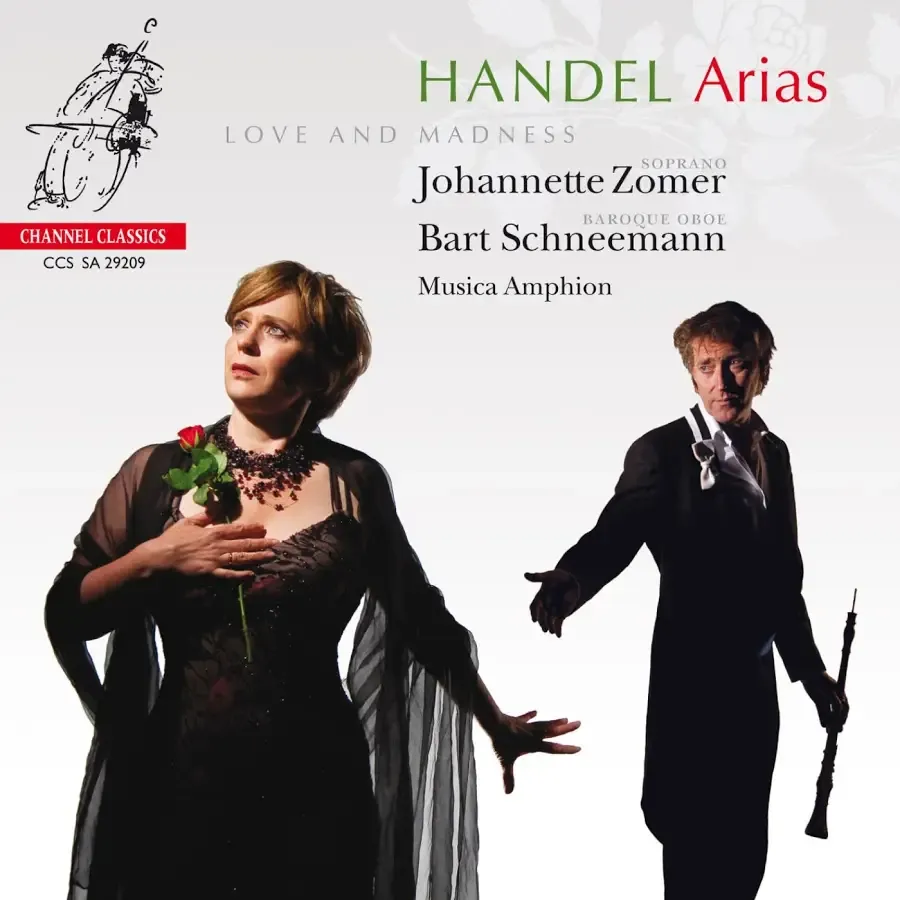
Johannette Zomer, Bart Schneemann, Musica Amphion – Handel Arias: Love and Madness (2009) [SACD / Channel Classics – CCS SA 29209]

Johannette Zomer, Bart Schneemann, Musica Amphion - Handel Arias: Love and Madness (2009)

Title: Johannette Zomer, Bart Schneemann, Musica Amphion – Handel Arias: Love and Madness (2009)
Genre: Classical
Format: MCH SACD ISO + DSF DSD64 + Hi-Res FLAC

Handel, a child of his time, was fascinated by the poignant human dramas and emotions exemplified by Greek and Roman classical myths, dramas and poetry. A theatre composer to his very bones, he was remarkably skilled in the portrayal of human psychology. The oboe was an instrument especially beloved by Handel and it is the unifying element in this fascinating anthology of arias and cantatas focusing on themes of love and madness sung by soprano Johannette Zomer. Zomer is accompanied by oboist Bart Schneemann and the ensemble Musica Amphion under direction of Jan-Pieter Belder.

Soprano Johannette Zomer, a frequent presence on Channel Classics recordings, begins most impressively with Berenice’s aria, displaying solid, centered tone and confident expressive character in a piece that also requires significant dialog with the oboe–which she and Bart Schneemann execute with engaging charm and remarkable timing. There’s even more drama to come in Medea’s aria from Teseo, “Morirò” (I shall die! But I shall die avenged…), and here Zomer shows her ability to command the opera stage, allowing us without any visual cues to experience the song’s full emotional impact, enlivened by the virtuosic support of the Musica Amphion orchestra. Although Zomer doesn’t shy away from the challenges of Handel’s more fast and florid creations, she’s really at her best in the slower arias–indeed, her “Lascia ch’io pianga” is among the best-ever recorded versions–as are her “Scherza infida!” and “Mi palpita il cor”, which rank with Handel’s most popular and most-frequently performed arias. In the past I’ve had my issues with Zomer’s voice–but I have no such reservations here, especially regarding the exceptionally well-controlled tonal modulations that she uses to great expressive effect, a mastery of technique that wasn’t always present on several of her previous recordings. Zomer and Schneemann (who also contributes a couple of instrumental works to the program) work very well together–two special voices, unique in timbre but united in interpretive style and concept. And the sound is Channel Classics’ usual first-class production. If we’re lucky these two superb musicians will find another good excuse to get together–and Channel Classics will be there to record it.

(more…)

3 min read

Scottish Chamber Orchestra, Joseph Swensen – Johannes Brahms: Violin Concerto & Hungarian Dances (2004) [SACD / Linn Records – CKD 224]

Scottish Chamber Orchestra, Joseph Swensen - Johannes Brahms: Violin Concerto & Hungarian Dances (2004)

Title: Scottish Chamber Orchestra, Joseph Swensen – Johannes Brahms: Violin Concerto & Hungarian Dances (2004)
Genre: Classical
Format: MCH SACD ISO + Hi-Res FLAC

Amazing recording!!! I’ve heard many, many versions of this concerto; it’s one of my favorite concertos, and Brahms – for me – is one of the greatest composers. This one has become one of my favorite versions (maybe even the most). It’s wonderfull to hear a soloist and orchestra play together that well; they’re all part of one big spirit. This version reveals a lot of details (even the finest), while the big/main line isn’t lost at all. And about the smaller size of the orchestra; I like it! Brahms often sounds ‘too heavy’ and thick, even sometimes troubled, when performed by some conductors/full orchestras. But using smaller orchestras doesn’t mean you’re being sure of getting a clear performance. In my opinion, Swensen leaves the version of Sir Neville Marriner e.g. (with Hilary Hahn) far behind, regarding the performance of the orchestra. I really don’t like the coloration and style of playing of the orchestra in that recording. Hilary Hahn’s playing, on the contrary, is beautiful. Swensen has succeeded (from my point of view) in making a great and very moving performance and recording of the Brahms voilin concerto. Coloration, choices of tempo, phrasing… in one word: brilliant! The Hungarian Dances are simply being performed with the same feeling for details and long lines. Whipping ‘gypsian’ drive being varied with moving lyricism. About the sonics… The sound of the recording is fantastic. The only thing I would like to have heard is a fraction more acoustic breath in the rear channels. But that’s a very small point. From the deapest bass-lines of the basses to the heighest hights; it sounds very natural and clear! Totally recommended! sa-cd.net

(more…)

2 min read

Hardy Rittner – Johannes Brahms: Early Piano Works Vol.2 (2008) [SACD / MDG – MDG 904 1538-6]

Hardy Rittner - Johannes Brahms: Early Piano Works Vol.2 (2008)

Title: Hardy Rittner – Johannes Brahms: Early Piano Works Vol.2 (2008)
Genre: Classical
Format: MCH SACD ISO + Hi-Res FLAC

Hardy Rittner seemed on top of his game both technically and interpretively in his first volume of Brahms’ early piano works, but for some reason he seems less assured and less interpretively attuned to Brahms’ music in this, his second volume. Performing the north German composer’s C major and F minor sonatas, Rittner does not bring out of the piano the massive sonorities the music’s out-sized chords require. This may be due in part to his choice of instrument. On the first volume, Rittner performed on a rich-toned 1851 Johann Baptist Streicher piano, but here he’s playing an 1850 Bösendorfer lacking both depth and resonance. As he did in the previous disc, Rittner does well with the poetic side of Brahms’ nature and his account of the F minor Sonata’s Andante espressivo is thoroughly persuasive. But when he needs to pour on the power as in the same sonata’s Finale, Rittner and his Bösendorfer can’t supply what’s wanted. Though Musikproduktion Dabringhaus und Grimm’s super audio sound is clear and present, this disc fails to live up to the promise of its earlier sibling. ~ Review by James Leonard allmusicguide
This second volume pairs the first and third sonatas, so now we have the complete sonatas in period performances. Instead of the Johann Baptist Streicher, an 1849/50 Bösendorfer is employed and gives a certain extra element of brightness, weight and tonal depth without sacrificing anything of the clarity that period instruments tend to bring to the proceedings. It is often said that Brahms was late in writing a symphony but Rittner’s playing shows that to be false; these works are symphonic in scope and scale – all that was left was for Brahms to produce an orchestration. Apart from capturing the grand sweep of the phrases and the structure of the compositions, Rittner also delivers on the poetry of the music. No detail escapes his attention but neither does it interrupt the musical narrative. The Scherzo movements of each sonata have a nice Viennese lilt to them and the slower movements a tender eloquence. The Finale’s are dazzling in their virtuosity yet Rittner’s playing is fully at the service of the music, not his self-aggrandisement. The recording from MDG, again a 2+2+2 production, is as clear and rounded as that in volume 1. Very highly recommended and one looks forward to future volumes. ~SA-CD.net

(more…)

3 min read

Joe Weed – The Vultures (1995) [Reissue 2003] [SACD / Top Music International Ltd. – TM-SACD 9801.2]

Joe Weed - The Vultures (1995) [Reissue 2003]

Title: Joe Weed – The Vultures (1995) [Reissue 2003]
Genre: New Age
Format: SACD ISO + Hi-Res FLAC

Joe Weed is a great guitar instrumentalist in the mood of 50’s and 60’s. This album performs acoustic versions of the dreamy Sleepwalk and the ’60s classic Wipeout and more! He is joined by David Grisman on mandolin, Rob Ickes on dobro, Todd Phillips on bass and Norton Buffalo on harmonica.

(more…)

1 min read