Hank Mobley – Mobley’s 2nd Message (1956) [APO Remaster 2012] [SACD / Analogue Productions – CPRJ 7082 SA]

Hank Mobley - Mobley's 2nd Message (1956) [APO Remaster 2012]

Title: Hank Mobley – Mobley’s 2nd Message (1956) [APO Remaster 2012]
Genre: Jazz
Format: SACD ISO + Hi-Res FLAC

Hank Mobley’s 2nd Message was recorded on July 27, 1956, just 1 week after its predecessor, Mobley’s Message. This 6 track quintet set features 3 Mobley originals alongside 3 standards & 1st rate accompaniment from trumpeter Kenny Dorham, pianist Walter Bishop, Doug Watkins on bass & Art Taylor on percussion. Analogue Productions’s superb SACD remastering is housed in a miniature recreation of the original LP packaging.

(more…)

1 min read

Hank Mobley, Lee Morgan – Peckin’ Time (1958) [APO Remaster 2011] [SACD / Analogue Productions – CBNJ 81574 SA]

Hank Mobley, Lee Morgan - Peckin' Time (1958) [APO Remaster 2011]

Title: Hank Mobley, Lee Morgan – Peckin’ Time (1958) [APO Remaster 2011]
Genre: Jazz
Format: SACD ISO + Hi-Res FLAC

Tenor saxophonist Hank Mobley was overshadowed by more influential tenors such as Sonny Rollins and John Coltrane during his career, but although he wasn’t deliberately flashy or particularly innovative, his concisely measured, round sax tone made him the perfect ensemble player and he was a fine writer, as well, a talent who has often been undervalued and overlooked. The Peckin’ Time session was recorded February 9, 1958 (the LP was issued a year later) and came in the midst of what was a period of whirlwind creativity for Mobley, who recorded work for the Savoy and Prestige imprints as well as six full albums for Blue Note (two were never released — it was not that uncommon for Blue Note to stockpile sessions at the time) in a little more than a year’s time (later Blue Note albums like Soul Station and Roll Call were still well in the future). For this session, Mobley found himself working with a young Lee Morgan on trumpet and in front of a fluid rhythm section that included pianist Wynton Kelly, bassist Paul Chambers, and drummer Charlie Persip, and it’s solid stuff, bright and always energetic. All but one of the tracks, a rendering of Kurt Weill’s “Speak Low,” were written by Mobley, and again, his hidden strength was always his writing, and it should probably come as no surprise that the best two tracks here, the title tune “Peckin’ Time” and the wonderful “Stretchin’ Out,” were both penned by Mobley. It all adds up to a fine program, and if Mobley didn’t push the envelope a whole lot, his lyrical and economical playing was always appropriate and graceful, and that’s certainly the case here.

(more…)

2 min read

Hank Mobley – Dippin’ (1966) [Analogue Productions 2011] [SACD / Analogue Productions – CBNJ 84209 SA]

Hank Mobley - Dippin' (1966) [Analogue Productions 2011]

Title: Hank Mobley – Dippin’ (1966) [Analogue Productions 2011]
Genre: Jazz
Format: SACD ISO + Hi-Res FLAC

Dippin’ is one of Hank Mobley’s finer moments, even considering that his entire Blue Note catalog is masterful, particularly his 1960s dates that reveal the depth and dimension of his understanding of harmonic invention — all in the name of groove and swing, of course. This date, recorded on a single day in June of 1965, netted four Mobley originals as well as two covers. The band included trumpeter Lee Morgan, pianist Harold Mabern, bassist Larry Ridley, and drummer Billy Higgins. The two-horn front line always served Mobley well. Here, with Morgan, the groove commences from the first notes of the title cut that opens the set. The short bluesy lines burst from the horns, and are turned inside out with elegant yet knotty lines that move the tune almost into pop territory but never venture far from the blues. The sprightly “Recado Bossa Nova,” written by Djalma Ferreira, moves the band outside its comfort zone rhythmically, but Mobley’s horn chart is brilliant. Higgins and Ridley keep the bossa groove natural and steaming as the soloists begin taking the tune apart and putting it back together. There is one ballad on the set, “I See Your Face Before Me” composed by Arthur Schwartz and Howard Dietz. On it, Mobley does his best Ben Webster, blowing low and smoky and sweet, but the truth is that it doesn’t belong on a program with so many hard bop swingers. The rest of the session is a pure joy and a fine document of Mobley’s abilities as a bandleader and composer.

(more…)

2 min read

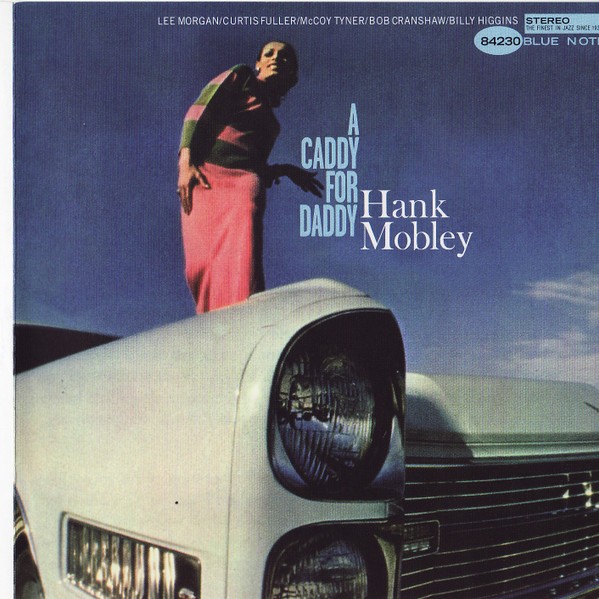
Hank Mobley – A Caddy For Daddy (2009) [SACD / Analogue Productions – CBNJ 84230 SA]

Hank Mobley - A Caddy For Daddy (2009)

Title: Hank Mobley – A Caddy For Daddy (2009)
Genre: Jazz
Format: SACD ISO

Analogue Productions’ Blue Note & Nat “King” Cole Reissues WIN A Positive Feedback 2010 Brutus Award! “…if you haven’t picked up every 1 of the Blue Note & Nat King Cole reissues from Chad Kassem & company at Acoustic Sounds, you’re really missing out!” – David W. Robinson, Positive Feedback, Issue 52 Hank Mobley was a perfect artist for Blue Note in the 1960s. On this LP, which is a straight reissue of the 1965 session, Mobley is joined by trumpeter Lee Morgan, trombonist Curtis Fuller, pianist McCoy Tyner, bassist Bob Cranshaw & drummer Billy Higgins (a typically remarkable Blue Note lineup) for the infectious title cut, 3 other lesser-known but superior originals, plus Wayne Shorter’s “Venus Di Mildew.” AllMusic: Hank Mobley was a perfect artist for Blue Note in the 1960s. A distinctive but not dominant soloist, Mobley was also a very talented writer whose compositions avoided the predictable yet could often be quite melodic & soulful; his tricky originals consistently inspired the young all-stars in Blue Note’s stable.

(more…)

1 min read

Hank Jones – ‘Round Midnight (2006) [Japan] [SACD / Eighty-Eight’s – VRCL-18830]

Hank Jones - 'Round Midnight (2006) [Japan]

Title: Hank Jones – ‘Round Midnight (2006) [Japan]
Genre: Jazz
Format: SACD ISO + Hi-Res FLAC

Henry “Hank” Jones Jr. was an American jazz pianist, bandleader, arranger, and composer. Critics and musicians described Jones as eloquent, lyrical, and impeccable. This album has been released for Japanese market as Hybrid SACD.

(more…)

1 min read

Hank Jones – My Funny Valentine (2005) [Japan] [SACD / Eighty-Eight’s – VRCL 18828]

Hank Jones - My Funny Valentine (2005) [Japan]

Title: Hank Jones – My Funny Valentine (2005) [Japan]
Genre: Jazz
Format: SACD ISO + Hi-Res FLAC

Henry “Hank” Jones Jr. was an American jazz pianist, bandleader, arranger, and composer. Critics and musicians described Jones as eloquent, lyrical, and impeccable. This album has been released for Japanese market as Hybrid SACD.

(more…)

1 min read

Hank Jones, Christian McBride, Jimmy Cobb – West Of 5th (2006) [SACD / Chesky Records – SACD313]

Hank Jones, Christian McBride, Jimmy Cobb - West Of 5th (2006)

Title: Hank Jones, Christian McBride, Jimmy Cobb – West Of 5th (2006)
Genre: Jazz
Format: MCH SACD ISO

Veteran pianist Hank Jones is hardly slowing down at the age of 87, as heard on this beautifully recorded session in early 2006. With drummer Jimmy Cobb (who sticks to brushes) and Christian McBride rounding out his potent trio, Jones keeps old warhorses like “On Green Dolphin Street” fresh, giving ample space to his partner and adding a humorous detour into Billy Strayhorn’s “Rain Check.” Other highlights include his elegant treatment of his late brother Thad’s timeless ballad “A Child Is Born” and a hard driving take of Charlie Parker’s “Confirmation.” McBride shows depth beyond his years with strong accompaniment and swinging solos. This Hybrid Super Audio CD, recorded without any gimmickry such as remixing or compression, enables the listener to enjoy these intimate performances as if sitting in the studio with the players.

(more…)

1 min read

Sir Colin Davis, London Symphony Orchestra And Chorus – Handel: Messiah (2007) [SACD / LSO Live – LSO0607]

Sir Colin Davis, London Symphony Orchestra And Chorus - Handel: Messiah (2007)

Title: Sir Colin Davis, London Symphony Orchestra And Chorus – Handel: Messiah (2007)
Genre: Classical
Format: MCH SACD ISO + Hi-Res FLAC

With an outstanding solo quartet and a great chorus and orchestra, Davis leads a sterling performance that challenges the supremacy of his 1966 Philips recording of Messiah. Davis leads a dramatic performance; the famous “Hallelujah” chorus appropriately grand, the final “Amen” bristling with brazen energy, both sung with extraordinary tonal coloring and precise articulation by the chorus, which also shines in a lithe “He shall purify” and a vividly virtuoso “For unto us a child is born.” Soprano Susan Gritton’s solos are a delight, whether in the measured “Behold, a virgin shall conceive” or her exuberant “Rejoice greatly.” The vocal purity of her “I know my redeemer liveth” makes this track a highlight. Alto Sara Mingardo’s darker tones are especially moving in her arias and dramatic in “He was despised.” The men are almost as good; Alistair Miles sonorous in the bass arias and Mark Padmore recovering nicely after a somewhat mannered “Evr’y valley.” The LSO is in excellent form too, the strings expressive in the orchestral interludes and the brass shining brightly in the big choruses of Part III, where the tympani thwacks are startling in their power.

(more…)

2 min read

Hamlet Piano Trio – Felix Mendelssohn: Piano Trios, Op. 49 & 66 (2015) [SACD / Channel Classics – CCS SA 36415]

Hamlet Piano Trio - Felix Mendelssohn: Piano Trios, Op. 49 & 66 (2015)

Title: Hamlet Piano Trio – Felix Mendelssohn: Piano Trios, Op. 49 & 66 (2015)
Genre: Classical
Format: MCH SACD ISO + Hi-Res FLAC

This Mendelssohn’s trios disc from the Hamlet Trio, a group just four years old, boasts performances that shine with confidence and immediacy. Good things abound: in the D minor, the second movement’s tempo is spot-on, and the piano’s opening soliloquy persuasively done, while the scherzo sizzles without losing sight of an underlying elegance. The opening Allegro energico of the C minor, too, is certainly not short on fire.

Three world-class musicians decided to join forces in 2011. As the Hamlet Piano Trio their reputation grows fast worldwide. All three have earned their stripes, both as soloists and as chamber musicians. The Dutch Italian and Italian Dutchman Paolo Giacometti is known as a soloist playing both modern and period instruments. Candida Thompson has been artistic leader of Amsterdam Sinfonietta since 2003, which under her leadership has developed into one of the most prominent chamber orchestras in the world and Serbian-Russian cellist Xenia Jankovic has earned praise in recital, performing all over the world. A keyboard trio is usually written for the harpsichord, fortepiano or piano, and violin (or flute) and cello. The genre developed in the mid-18th century from the so-called Baroque trio sonata and the harpsichord sonata. A trio sonata is a work with three melodic lines or parts played by one, two or three instruments. Bach, for example, wrote trio sonatas for the organ, in which the three melodic lines are played by the right hand, left hand and pedal. The same piece could also be played by two violins or flutes and a bass instrument (harpsichord, cello or viola da gamba, for instance). The bass part could also be played by two or more instruments together: a melodic instrument such as the viola da gamba, cello or bassoon, and a chordal instrument such as the harpsichord, organ or lute. The official name of the bass part is basso continuo, i.e. a bass line which is ever-present, forming the supporting foundation for the composition as a whole. Another possibility was to play one of the upper parts on the violin or flute and the other two parts on the harpsichord. In this manner the three melodic lines were shared by two instruments. The harpsichord, which had been the humble servant of instruments with greater aspirations, thus became an equal partner with a fully-fledged role. The technical term for this role is ‘obbligato’, meaning obligatory. This is the general background to one of the most popular genres of classical chamber music, the piano trio, as we are familiar with it in the music of Haydn, Mozart, Beethoven, Schubert and Mendelssohn.

(more…)

3 min read

Hall & Oates – Voices (1980) [MFSL 2013] [SACD / Mobile Fidelity Sound Lab – UDSACD 2114]

Hall & Oates - Voices (1980) [MFSL 2013]

Title: Hall & Oates – Voices (1980) [MFSL 2013]
Genre: Rock
Format: SACD ISO + Hi-Res FLAC

At the close of the ’70s, Hall & Oates began inching toward a sleek, modern sound, partially inspired by the thriving punk and new wave scene and partially inspired by Daryl Hall’s solo debut, Sacred Songs, a surprising and successful collaboration with art rock legend Robert Fripp. While 1979’s X-Static found the duo sketching out this pop/soul/new wave fusion, it didn’t come into fruition until 1980’s Voices, which was their creative and commercial breakthrough. Essentially, Voices unveils the version of Hall & Oates that made them the most successful duo in pop history, the version that ruled the charts for the first half of the ’80s. During the ’70s, Hall & Oates drifted from folky singer/songwriters to blue-eyed soulmen, with the emphasis shifting on each record. On Voices, they place their pop craftsmanship front and center, and their production (assisted by engineer/mixer Neil Kernon) is clean, spacious, sleek, and stylish, clearly inspired by new wave yet melodic and polished enough for the mainstream. Thanks to the singles “Kiss on My List” and “You Make My Dreams” (and, to a lesser extent, their remake of the Righteous Brothers’ “You’ve Lost That Lovin’ Feeling” and the original version of the heartbreaking ballad “Everytime You Go Away,” later popularized by Paul Young), the mainstream enthusiastically embraced Hall & Oates, and the ubiquitousness of these hits obscures the odder, edgier elements of Voices, whether it’s the rushed, paranoid “United State,” tense “Gotta Lotta Nerve (Perfect Perfect),” the superb Elvis Costello-styled “Big Kids,” the postmodern doo wop tribute “Diddy Doo Wop (I Hear the Voices),” or even John Oates’ goofy “Africa.” Apart from the latter, these are the foundation of the album, the proof that the duo wasn’t merely a stellar singles act, but expert craftsmen as writers and record-makers. The next few albums were bigger hits, but they topped the charts on the momentum created by Voices, and it still stands as one of their great records.

(more…)

2 min read